AI Deepfake Attacks: Can You Trust What You See?
November 23, 2026
Imagine receiving a video call from your company's CEO. The face looks familiar, the voice sounds right, and the person asks you to approve an urgent financial transfer. Would you trust it? This is exactly the kind of situation that makes AI deepfake attacks dangerous. At Revelar Solutions, we believe businesses need to understand how digital trust can break down as artificial intelligence becomes more accessible. Just as a business needs reliable website security solutions, it also needs clear procedures to verify the people behind digital communications.
Deepfakes have changed the way people think about online identity. A convincing video or voice recording no longer proves that someone is genuine. For businesses, this creates new challenges involving fraud, privacy, reputation, and information security.
So, how can organizations protect themselves when seeing and hearing are no longer enough?
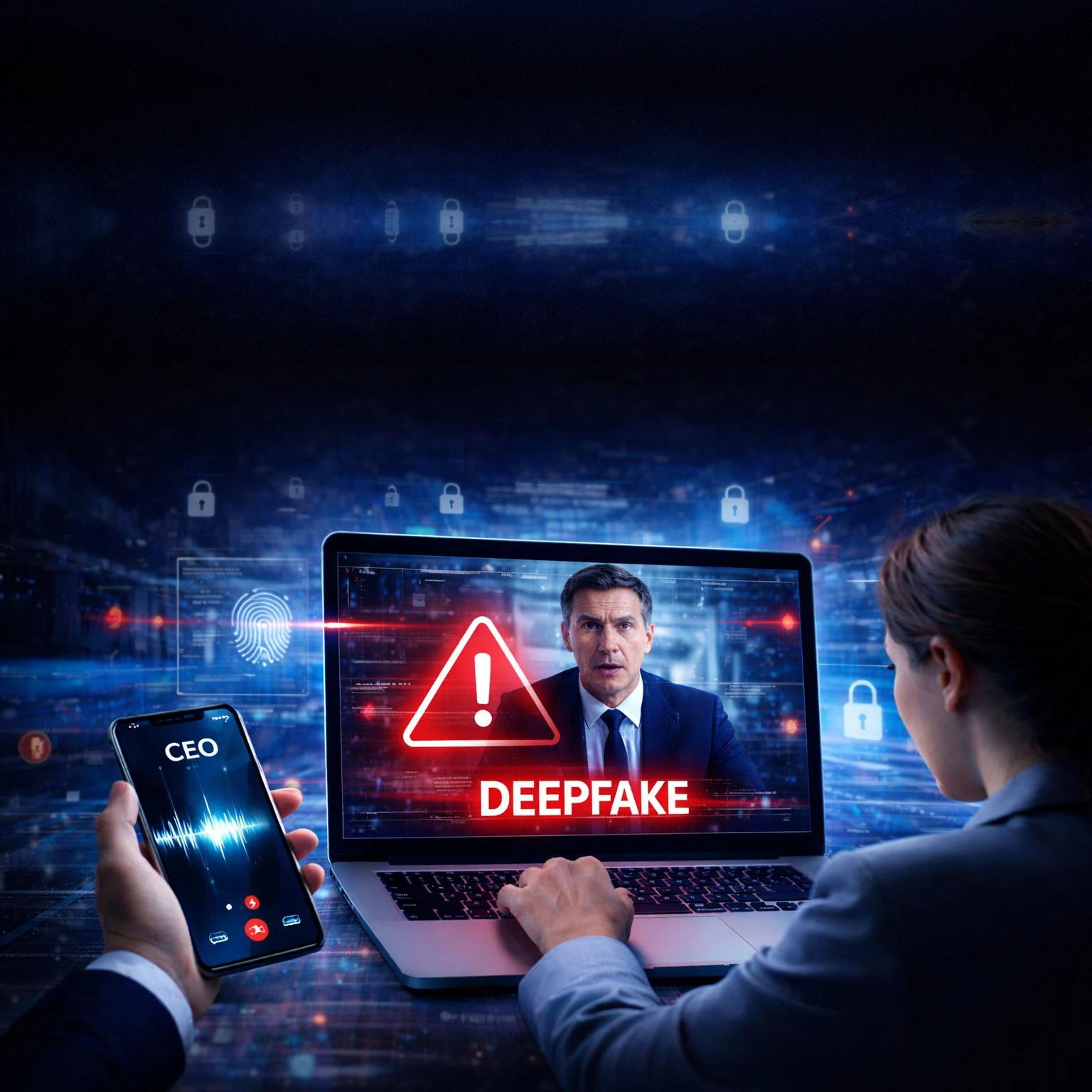 Deepfake video call
Several factors make these attacks particularly concerning.
 Business cybersecurity protection
 Importantly, the OWASP AI Testing Guide is a testing resource, not a guarantee that an AI model is completely secure. Organizations should combine structured testing with ongoing monitoring, human oversight, and appropriate security controls.
What Are AI Deepfake Attacks?
AI deepfake attacks use artificial intelligence to create or manipulate images, videos, and audio recordings that make someone appear to say or do something they never actually did. Attackers can use publicly available photographs, voice recordings, and video clips to imitate individuals. They may impersonate company executives, employees, family members, public figures, or customer support representatives. For example, a criminal might use an executive's publicly available speech to create a voice imitation. They could then contact an employee and request confidential information or an urgent payment. The problem isn't limited to fake videos. Attackers can also combine deepfakes with phishing emails, fake websites, social engineering, and stolen account credentials. In other words, the technology creates the disguise, while social engineering provides the excuse.Why Are Deepfake Attacks Becoming a Cybersecurity Concern?
AI tools have made synthetic media creation more accessible. Attackers no longer need advanced video-editing skills to attempt convincing impersonation. The FBI has warned about malicious campaigns involving AI-generated voice messages and impersonation of senior officials. Its May 2025 advisory also explains how criminals can use AI-generated voices to imitate known contacts.Deepfake video call1. Voice Cloning Makes Impersonation Easier
A familiar voice can create an immediate sense of trust. Employees may feel comfortable responding to a manager, director, or business owner without checking the request. Attackers exploit that familiarity to encourage quick decisions.2. Video Calls Can Create False Confidence
Many organizations treat video calls as a reliable way to confirm someone's identity. However, manipulated video or real-time impersonation can undermine this assumption. A familiar face on a screen should not automatically authorize financial transactions or access to sensitive information.3. Attackers Exploit Urgency and Emotions
Deepfake scams often involve pressure. A supposed executive might request an immediate payment. A fake family member might claim to need emergency assistance. A fabricated company announcement might encourage employees to open a malicious link. When people feel worried or rushed, they may skip normal verification procedures.4. Fake Content Can Damage Business Reputation
Imagine someone publishing a fabricated video showing a company representative making offensive statements. Even after the company proves the video is fake, customers may question its credibility. That is why deepfake attacks create both technical and reputational risks.How Can You Identify a Potential Deepfake?
There is no single visual or audio clue that reliably identifies every deepfake. Some manipulated content contains noticeable inconsistencies, while other examples can appear highly realistic. Still, a few warning signs deserve attention.-
Unusual facial movements: Look for unnatural expressions, inconsistent blinking, or strange mouth movements.
-
Audio inconsistencies: Notice unusual pauses, unnatural speech patterns, or mismatches between speech and lip movement.
-
Lighting problems: Facial lighting, shadows, and background details may appear inconsistent.
-
Unexpected requests: Be cautious when someone suddenly requests money, passwords, confidential files, or verification codes.
-
Unusual communication channels: A familiar person contacting you through an unfamiliar number or account deserves additional verification.
Real-World Risks of Deepfake Attacks for Businesses
Deepfake attacks can affect businesses of different sizes. Small companies may have fewer verification controls, while large organizations may have more employees, communication channels, and potential targets. Here are some important business risks.Financial Fraud
An attacker impersonates a senior employee and requests an urgent bank transfer. If the employee trusts the video or voice message without checking the request, the company could lose money.Corporate Identity Theft
Criminals may imitate executives or employees to gain access to business accounts, internal documents, or confidential conversations.Data and Privacy Breaches
An impersonated employee might convince another team member to share customer records, login credentials, or internal business information.Brand Reputation Damage
Fake interviews, fabricated announcements, and manipulated executive videos can spread misleading information about a company.Customer Support Scams
Attackers may imitate customer service representatives to collect personal information, payment details, or account credentials from unsuspecting customers. The FBI's July 2026 advisory describes AI-generated videos used in impersonation schemes alongside spoofed websites designed to collect personal information.7 Practical Ways to Protect Your Business From Deepfake Attacks
Businesses should build security around verification rather than appearance. The following practices can reduce the risk of impersonation and social engineering.Business cybersecurity protection1. Introduce Independent Identity Verification
Never approve a sensitive request based only on a voice message or video call. For financial transfers, confidential information, or account changes, use a separately verified phone number or an established internal approval process. For example, if your CEO requests an urgent payment through a video call, confirm the request through the company's approved communication channel.2. Establish Multi-Step Payment Approvals
Businesses should create clear financial approval procedures. Require additional authorization for high-value transfers, changes to supplier bank details, and unusual payment requests. A second approval may feel inconvenient during a busy workday, but it costs far less than investigating a fraudulent transfer.3. Use Multi-Factor Authentication
Multi-factor authentication (MFA) adds another layer of protection to business accounts. Even if an attacker obtains a password, MFA can make unauthorized access more difficult. Organizations should prioritize MFA for email, financial systems, cloud platforms, and administrative accounts.4. Train Employees to Recognize Social Engineering
Employees need to understand that deepfake scams target human behavior, not just computer systems. Training should cover suspicious requests, unexpected video calls, fake executive messages, phishing links, and requests for confidential information. Most importantly, employees should feel comfortable questioning unusual instructions without worrying about upsetting senior management.5. Protect Your Website and Business Applications
A company's website and connected applications can expose sensitive information when security controls fall short. Regular updates, secure authentication, access restrictions, vulnerability assessments, and secure development practices help reduce common risks. Professional Application Security Services can help organizations identify weaknesses in their applications before attackers exploit them.6. Monitor Accounts and Communication Systems
Businesses should review unusual login attempts, account changes, unexpected access patterns, and suspicious messages. Security monitoring can help teams investigate potential incidents before they develop into larger problems.7. Prepare an Incident Response Plan
Even strong security controls cannot guarantee that every attack will fail. Businesses should know whom to contact, how to secure affected accounts, how to preserve evidence, and how to notify relevant stakeholders. A documented response plan helps teams act quickly instead of making important decisions during a crisis.How Cybersecurity Companies Are Using the OWASP AI Testing Guide to Audit AI Models
As organizations introduce AI-powered tools into their operations, security testing must cover more than traditional software vulnerabilities. The OWASP AI Testing Guide, Version 1.0, was officially released on November 26, 2025. It provides a structured methodology for evaluating AI system trustworthiness across application, model, infrastructure, and data layers. Cybersecurity teams can use its methodology to assess several important areas:-
Input security: Test whether attackers can manipulate model inputs or exploit prompt injection vulnerabilities.
-
Data protection: Examine whether an AI system exposes sensitive information through its responses.
-
Model robustness: Evaluate how the system handles adversarial inputs and unexpected scenarios.
-
Application security: Check the security of APIs, integrations, and AI-powered application components.
-
Access control: Review whether users and connected systems have only the permissions they need.
-
Output safety: Examine whether the model produces harmful, misleading, or unauthorized outputs.
Why Businesses Need a Cybersecurity Strategy That Includes AI
Traditional cybersecurity remains essential, but businesses must also consider how AI changes existing attack methods. A strong security strategy should address identity verification, application security, data protection, access management, employee awareness, and incident response. Working with a cyber security services company can help organizations assess their current security posture, identify vulnerabilities, and develop practical protection strategies. This does not mean every business needs an expensive collection of security tools. It means choosing appropriate controls based on the company's systems, information, operations, and risk exposure. Revelar Solutions believes effective security starts with understanding actual business risks rather than simply purchasing more software.A Practical Perspective: Why Verification Matters More Than Ever
One important lesson from understanding deepfake threats is that familiarity should never replace verification. Consider a common workplace situation: an employee receives an urgent message that appears to come from a senior manager. The message requests a confidential document and insists that nobody else needs to know. The employee recognizes the manager's name and communication style. However, instead of immediately sharing the document, the employee contacts the manager through the company's official communication channel. That small step can prevent a potentially serious security incident. This is a practical security lesson rather than a claim that every such incident has occurred at a particular company. It reflects an important principle: security procedures should work even when people cannot confidently identify manipulated media. Businesses should build a culture where employees can pause, question unusual requests, and verify identities without hesitation.How Revelar Solutions Can Help Strengthen Your Digital Security
Modern businesses depend on websites, applications, cloud platforms, and digital communication. Protecting these systems requires a thoughtful approach to security. At Revelar Solutions, we understand the importance of building reliable digital infrastructure and reducing avoidable security risks. Our technology services include:-
Website development with security-conscious practices.
-
Application security considerations during software development.
-
Technical assessments and IT consulting.
-
Cloud infrastructure and DevOps solutions.
-
Secure system planning and implementation.
Frequently Asked Questions
1. What is an AI deepfake attack?
An AI deepfake attack uses manipulated or AI-generated audio, video, or images to impersonate someone. Attackers may use this technique for financial fraud, identity theft, phishing, or spreading misinformation.
Can AI deepfakes fool video calls?
Yes. AI-generated or manipulated video can make impersonation attempts more convincing. Organizations should use independent identity verification instead of relying only on someone's appearance during a video call.
How can businesses protect themselves from deepfake scams?
Businesses should introduce independent identity verification, multi-factor authentication, payment approval procedures, employee awareness training, and incident response plans.
Can deepfakes steal company information?
Yes. Attackers can use impersonation to convince employees to share passwords, confidential documents, customer information, or access credentials.
5. Are deepfake detection tools reliable?
Detection tools can help identify suspicious content, but they cannot guarantee accurate results in every situation. Businesses should combine technical detection with identity verification and established security procedures.